Tuesday, October 11, 2016

Week 8 Growth Mindset


     I'll be the first to admit that this semester has been unlike any other semester I have experienced at OU in the four and half years that I have been attending. I have been put to the test physically and mentally more than ever. It was the first or second week of school that I was hit head on by a girl who was texting and driving, which left me in some rough physical shape. I get better each week as I progress through therapy at the chiropractor. Maybe 2 - 3 weeks after that, I caught a sinus infection that turned into bronchitis. I had to have a strep test twice during that period because my throat was so swollen and irritated. Just last Wednesday, I lost my childhood best friend. His funeral was yesterday and it had been rough. So have I grow out of this? I'd like to think so. Actually, make that a firm 'yes'!
     I struggled to get the work together for this class in the first couple weeks as I was trying to make sense of a schedule that was going to best work for me, yet I was struggling to figure out what a 'normal week' would look like. At this point, I just assume that every other week or so something will happen that I have to add to my plate and learn to juggle with everything else.
     I have realized that one of my biggest weaknesses is that I strive to enjoy as much of life as possible. When I say that, I mean to emphasis that through everything I have been overcoming and hurdling this semester, I try to enjoy the time I have with my friends and family and put off my homework. I have made strides to change that. Although life is precious, there is a time for everything. In the last couple weeks, I have made school a #1 priority again and pushing myself through the obstacles in order to learn. To learn that even though life can make you feel bogged down and exhausted, you earn your stamina through perseverance.
      The dimensions of growth that apply to me are pushing myself to go farther, finding motivation inside myself, being confident that I can improve, and setting my own schedule and priorities.

I chose this GIF because my crutch through all of this, like many students can relate to, has been coffee. I am a Starbucks junkie and like to do most of my writing and homework there. So I felt like this was an appropriate photo to share because there are multiple times throughout the day that I feel like the coffee can't come fast enough. I should just begin coffee consumption through and IV.
(P.S. My favorite drinks is a Venti Cold Brew with a splash of 2%, 1 pump of classic and 1 pump of vanilla.)

Image result for miranda presley
Character Miranda Priestly in 'Devil Wears Prada'

Wednesday, October 5, 2016

Reading Notes: Jamaica

Mango Tree
What's a better way to take notes than with some forest scenery!

Brainstorming notes over the short stories of Jamaica:

The trickster Spider Anansi is a famous folklore figure in West Africa, and slaves abducted from West Africa brought the stories of Anansi with them to the Americas.

Use the story of the grub-grub peas and write it in the setting of slavery. This would be good because the story of Anansi the spider comes from Africa and spread when slaves were brought to America.

In order to make the story longer, tie in the story of 'Tiger as the Riding-Horse' once Anansi has escaped from the tree.

Use a good portion of dialogue in the second half, or try to balance it more throughout the story without overloading it.


Anansi - the spider
Here is a picture provided that can be used in the story to provide the audience with a visual.

Bibliography:

This book of Jamaica Anansi Stories contains stories collected in Jamaica during the early years of the 20th century by Martha Warren Beck with, a professor of folklore and well-known ethnographer. 


Wednesday, September 28, 2016

Reading Notes: The Monkey King

Chinese Painting - 2016

Here is a link to the story.


Monkey is born out of a stone egg.
stone monkey climbs waterfall to iron gates that are curtained by waterfall.
--
Monkey faces his own mortality and ventures out in search of 1 of 3 ways to achieve immortality.
--
Is given his name Sun Wu King (look up to see if its possibly significant? maybe find something to use as a character name in a story?)
He learns the art of eternal life and a power to fly
he is banished for showing off
Gets into a fight with a giant devil because he took his children and attempted to invade his home.
the following stories are stories about his fights with the king and queens and to the nether world.
--
I think this will be good to do as a story for the portfolio


Bibliography:

This story is part of the The Monkey King unit. Story source: "The Ape Sun Wu Kung" in The Chinese Fairy Book, ed. by R. Wilhelm and translated by Frederick H. Martens (1921).

Wednesday, September 21, 2016

Tech Tip: How to Screenshot

SCREENSHOT!


     I don't know about you all, but having the ability to screen shot or take snap shots of something on my computer is very handy. It actually saved my grade once when it came to doing a submission for a class online and I took a screenshot that I was in the middle of the submission when the clock struck 12 (Note: don't procrastinate).

So I wanted to share a Tech Tip of how to screen shot on your computer!
*It is different depending on the type of computer you have

     Windows:
     In Windows, PrintScreen key copies the whole screen image, as a graphic, onto your invisible Clipboard, so you can paste into an e-mail message or any other program (“This is what I’m seeing! What do I do now?!”). If you add the Alt key, you copy only the front window.
     Apple:
     On the Mac, press Command-Shift-3. (Command is the key with the propeller on it, next to the Space bar.) You hear a snapshot sound, and you get a graphics file on your desktop—a picture of the entire screen image.
     *If you press Command-Shift-4 instead, you get a crosshair cursor; you can draw across just one portion of the screen. Or, if you now tap the Space bar, you turn the cursor into a little camera icon. You can now click on just one window or toolbar that you want to copy.
     BONUS:
     In both cases, you can hold down the Control key to copy the image to the Clipboard instead of leaving a file on the hard drive.
This is a snippet of my computer screen as I write this blog to demonstrate the action.
2016

If you want to learn more fun Tech Tips, check out this link!

'25 More Tech Tips 7 Tricks'
By David Pogue of the New York Times
http://pogue.blogs.nytimes.com/2011/05/19/25-more-tech-tips-and-tricks/?_r=0

Tuesday, September 20, 2016

Reading Post: Fables of Bidpai (Part B)

Illustration by: E. Boyd Smith - 1908
http://mythfolklore.blogspot.com/2014/07/bidpai-hare-fox-and-wolf.html
2016
The Hare, the Fox, and the Wolf:
This story works great because of the cleverness of the Fox. Think about using this story but mythological characters stead of the wolf and the hare. Maybe a sheep and something else?

The Sparrows and the Snake:
Just seems like another story. Does not have a very interesting plot or lesson.

The Frog, the Crab, and the Serpent:
another story about an animal trying to take care of its young, but the young get eaten and the mother this time as well.

The Blind Man and the Snake:
I liked this story for its simplicity. Its very different from the other stories in this series of fables. It teaches the lesson of trust and simple arrogance.

The Camel Driver and the Adder:
An even better story than the previous. The characters are a little different, but this would be a great story to write and use with just changing the characters and adjusting the words. Teaches a good lesson and is the perfect length.

The Tortoise and the Geese:
teaches about the consequences of talking to much. I good story, but not the one to write about.

The Scorpion and the Tortoise:
Nothing really to note. Another fable that did not strike too much interest.

The Crane and the Crab:
I thought I saw the ending to this before it ended, but the crab at the end was a very nice twist.

The Lean Cat and the Fat Cat:
Good story. It's about being content with what you have.

Three Bird Stories:
These short stories were well written and very concise, but provide no real interest in replicating.

The Partridge and the Hawk:
From reading this story just in the beginning, I am realizing that A LOT of the stories in this class are about animals and people trying to make friendships and offers with one another in a very short and upfront demeanor. People today are not like that what-so-ever anymore. This story, like many others, demonstrates that the food chain is very prevalent in deciding who survives these stories and who doesn't. Even thought the hawk in this story is not well and the partridge is well, the partridge still dies. Maybe I am missing a theme in these types of stories, but logically it does not make sense.


The Crow, the Jackal, the Wolfe, and the Camel:
Don't ask me why, but before I read this I already have high expectation from the title alone.
After having read the story, I am pleased with the lesson. It teaches of naïve behaviors and the outcome. Yet another story about the food chain and it's weighing balance in fable stories. This would be a good one to write about as well because it is good and has length.

Three Fish:
A story that demonstrates quick wit being the savior of ones own life.

The Lion and the Hare:
This story is a good ending read to the series of fables. It teaches about ignorance, naïve behaviors, arrogance and cleverness. I like the idea of writing about this one as well.


Bibliography:
Author: Maude Barrows Dutton
Title: The Tortoise and the Geese and other Fables of Bidpai
Link: http://mythfolklore.blogspot.com/search/label/Unit%3A%20Bidpai

Monday, September 19, 2016

Reading Notes: Fables of Bidpai (Part A)


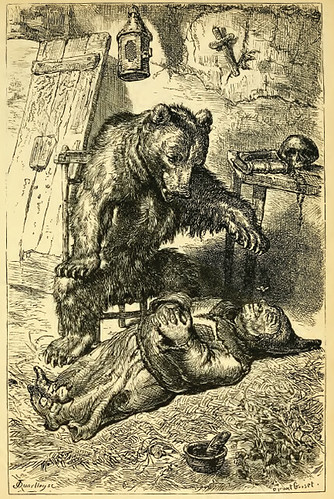
Ursus et Heremita
Griset illustration of La Fontaine
from The Gardener and the Bear
http://mythfolklore.blogspot.com/2014/07/bidpai-gardener-farmer-tyrant.html
2016

Reading Notes: Fables of Bidpai

Based on the introduction, flip a story to be like taking this class. Thousands of books and stories to be read and not a single person can read them all. So a class is assigned to read them and even they can't read them all. It took 20 years of different classes to complete the work.

Rustic and Nightingale:
Being rewarded for stopping a menacing behavior. (Not very interesting)

The King, the Falcon, and the Drinking-Cup:
a character with a companion (think animal) that saves his life twice from poison but is killed by his master. Master learns of poison and drinks the water to be with animal

The Two Travelers:
a story about bravery versus cowardly personalities  (rewards bravery)

Poor Man, Rich Man, Young Man:
3 part stories of each man
poor: aspirations for future development
rich: disregards the poor and ends up poor
young: aspires to be lazy and cared for and withers away only to realize mistakes

The Merchant and His Iron:
man lends iron, iron is eaten by rats, sparrow hawk eats rats, man tells sparrow eats boy, offers to return boy for lost iron.

Gardener, Farmer, Tyrant:
-The Gardener and the Bear
Better to have a wise enemy than a foolish friend.
Think of a funny and short story that replicates this.
Use the fly as a good analogy as the wise enemy.
-The other stories did not spark any interest for stories.

The King, the Hermit, and the Two Princes:
sons fights for wealth of their father, father keeps is from them, one learns of the spoils going dry and the other learns of nobility fand unselfish livelihood. Flip this into something more modern like trust fund kids and oil money. The father needs a person to give the money to until then.

Three Stories about Apes:
1) Don't mess with other's business
2) Smart bird pesters the foolish apes, ends up dead.
3) Greedy hog overlooks his manners as a guest.

The Ass, the Lion, and the Fox:
a very interesting read, but I'm not too sure what it entirely means just yet. I will need to reflect more upon the story to grasp the full theme.

Bibliography:

Author: Maude Barrows Dutton
Work: The Tortoise and the Geese and Other Fables of Bidpai
Link: http://mythfolklore.blogspot.com/search/label/Unit%3A%20Bidpai

Sunday, September 18, 2016

Feedback Focus

Reading Out Loud:

So I tried this technique out by reading to my dog. I made a point to read it to my dog since I typically like to proof read out loud anyways, but I wanted to make it more direct than just reading to the open air. I found that by doing it this way, I was focusing more on the inflection in my voice and attempting to make the story run smooth. I was able to read the passages and notice more about the flow of dialogue compared to just general reading. Definitely a 5 star on my ranking for how to stay focused with reading passages. It helps to jot notes while reading to you dog, fish, cat, whatever. They won't mind, I promise. :)

Copy-and-Delete:

For this technique I actually put the text of 'What Makes Lightning' into Written? Kitten! I liked this source by the way because it generate a new image as you write. But in terms of paraphrasing after each paragraph, I noted that I don't form complete sentences. I see that I try to cut down the authors writing. This is a good way to take notes of someone else writing if you are trying to provide feedback, such as if the author is staying on topic, if the character developed and emotional change, and just noting general notes of a story's progress. This will be a good way to take notes for weekly readings for a variety of different classes and being able to recall information without having to reread a paragraph or story. This isn't a good focus tool for proof-reading your own writing, but great for taking notes of others. 4 stars.

Use a Timer:

I didn't like this method what so ever. I caught myself paying more attention to the timer than to the readings. It may be my inner ADHD and useful for others, but I am not a fan. This is good for cutting corners on reading and getting the general gist of stories, but I don't find it useful for retaining focus on your own writings or providing a good way to give feedback. 1 star.

http://writtenkitten.co
2016